One year ago there were riots and clashes in Charlottesville, VA. President Trump was criticized for days for one comment he made regarding the violence. This is from the NY Times on 8-12-17.
By Glenn Thrush and Maggie Haberman
BRIDGEWATER, N.J. — President Trump is rarely reluctant to express his opinion, but he is often seized by caution when addressing the violence and vitriol of white nationalists, neo-Nazis and alt-right activists, some of whom are his supporters.
After days of genially bombastic interactions with the news media on North Korea and the shortcomings of congressional Republicans, Mr. Trump on Saturday condemned the bloody protests in Charlottesville, Va., in what critics in both parties saw as muted, equivocal terms.
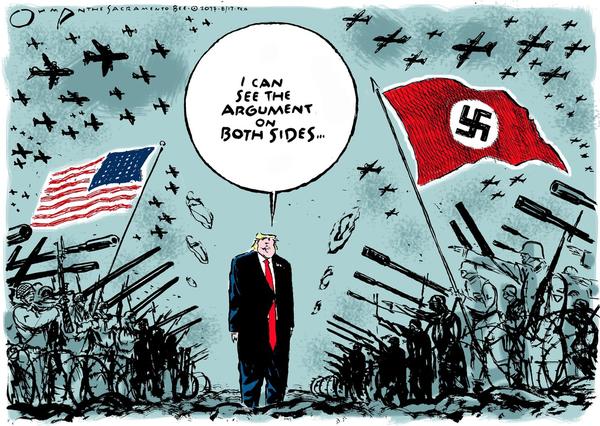
During a brief and uncomfortable address to reporters at his golf resort in Bedminster, N.J., he called for an end to the violence. But he was the only national political figure to spread blame for the “hatred, bigotry and violence” that resulted in the death of one person to “many sides.”
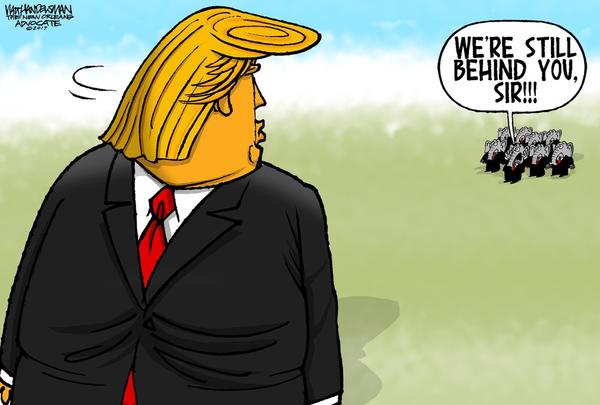
For the most part, Republican leaders and other allies have kept quiet over several months about Mr. Trump’s outbursts and angry Twitter posts. But recently they have stopped averting their gazes and on Saturday a handful criticized his reaction to Charlottesville as insufficient.
“Mr. President we must call evil by its name,” tweeted Senator Cory Gardner, Republican from Colorado, who oversees the National Republican Senatorial Committee, the campaign arm of the Senate Republicans.
“These were white supremacists and this was domestic terrorism,” he added, a description several of his colleagues used.
Democrats have suggested that Mr. Trump is simply unwilling to alienate the segment of his white electoral base that embraces bigotry. The president has forcefully rejected any suggestion he harbors any racial or ethnic animosities, and points to his son-in-law, Jared Kushner, an observant Jew, and his daughter Ivanka, who converted to the faith, as proof of his inclusiveness.
In one Twitter post on Saturday, Mr. Trump nodded to that inclusiveness.
“We must remember this truth: No matter our color, creed, religion or political party, we are ALL AMERICANS FIRST,” the president wrote, a statement that had echoes of his campaign slogan, America First.
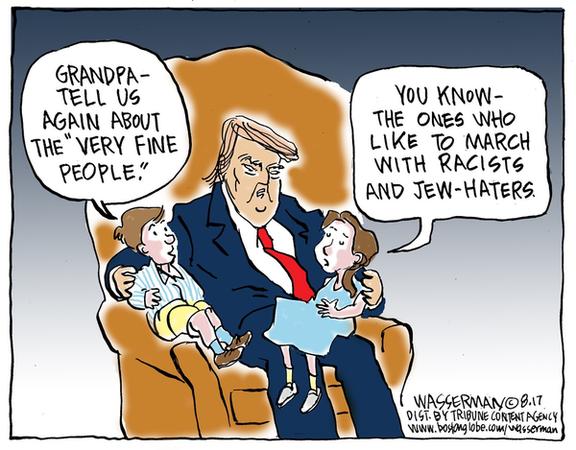
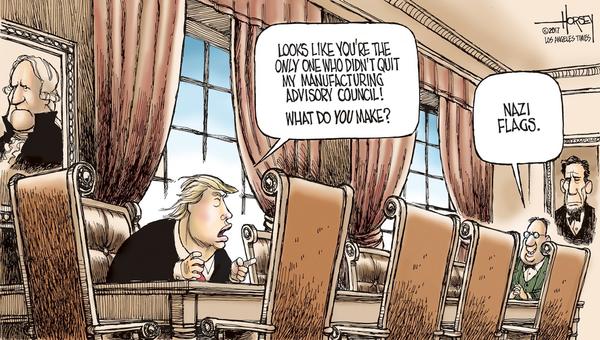
The criticism continued for days. Republicans often led the attack. Trump was branded a racist for even suggesting there were two groups there that were wrong, the far right and ANTIFA. The media feeding frenzy was intense. CEO’s dropped of his corporate advisory board and he shut it down.
The two groups decided to do it again and make it an annual affair.
Guess what. The far right protesters were scare and did no damage. The left that Trump spoke about and received severe treatment for a simple statement did all the damage. Are the Republicans who went after Trump last year in this fight. Hell, no the choir boy Ryan in leaving and not soon enough. Will probably be the Democratic candidate for President in 2020. Is this a big story in the media as it was last year, hell no. Where are those Democrats who went after Trump last year. Silent as their radicals behaved worse than the far right did last year.
The only redeeming thing from this whole mess is who got the brunt of the ANTIFA redicals. The press.
Antifa protesters couldn’t find any fascists at Unite the Right — and harassed the press instead

Journalists photograph a type of smoke grenade placed by Antifa activists in the middle of 17th street during a rally in Washington on Sunday. (Craig Hudson/Charleston Gazette-Mail via AP)
Antifascists, according to their own doctrine, fight fascism. Sounds simple enough.
Granted, members of the loosely organized Antifa movement define “fascism” vaguely — to include not just Nazis and neo-Nazis, but also white supremacists, white nationalists and the broader population of racists.
As for the fighting, Antifa takes that part of the doctrine literally. Claiming that even a small public gathering of fascists is a threat to freedom, the movement condones physical violence against them. Its anonymous, black-clad members routinely crash far-right demonstrations to brawl.
So — you might expect that when Antifa can’t find any fascists, it has nothing to fight. That seemed to be the situation this weekend, when a long-planned rally for far-right extremists fizzled into a paltry gathering of a few dozen white supremacists, unapproachable and nearly invisible behind a police blockade as they met without incident in a Washington D.C. park.
And yet Antifa still managed to fight — not fascists this time, but reporters.
Sunday’s event had been advertised as a sequel to the massive, deadly “Unite the Right” rallies in Charlottesville last year. Organizers had hoped to draw hundreds of racists from across the country, but instead managed to bring fewer than 40 people to Lafayette Square.
By contrast, thousands of protesters surrounded the park to shout the racists down and drown out their speeches.
A few blocks away, several dozen masked Antifa members marched up 13th Street in the early afternoon. They carried the movement’s red-and-black flag, and some wore makeshift body armor even though no fascists were anywhere in sight.
When a Washington Post reporter tried to interview the antifascists, they refused to speak. When he followed them up the street with his cellphone camera, one of them shoved a black umbrella into his lens and several shouted: “No photos!”
“This can harm us,” one of the protesters said, just before someone swatted the reporter’s iPhone out of his hand and threw it into the middle of the street.
The reporter and camera were fine, but the incident was hardly isolated. Throughout the day, journalists covering the rally shared stories of cameras being yanked and reporters accosted by members of the same movement that claims it is protecting free society.
At the same event, NPR reporter Tim Mak watched Antifa protesters lob fireworks and bottles at the police separating them from the white supremacists.
Then he ducked as someone whipped an egg at his head.
Mak noted that Antifa’s showing was dwarfed by thousands of other people who peacefully protested the white supremacists. “I was not marked as press,” he wrote, “and have no reason to believe it was thrown at me because I am a reporter.”
But other videos show Antifa members accosting reporters specifically because they’re reporters, in scenes reminiscent of Donald Trump campaign rallies where the press was often treated as enemy.
“Are you going to report how many people they tear gassed?” a self-described Antifa member screams at two reporters, as seen in video published by the right-wing website Breitbart.
“Of course I will,” a photographer replies. “That’s what I’m doing.”
A man in a bandana lunges into the camera frame, screaming expletives at the journalists.
“Ask questions!” the woman scolds them. “Don’t just keep taking pictures.”
“We do both!” says a woman who identified herself as a USA Today reporter. “I’m just trying to do my job, man.”
It was a similar scene in Charlottesville, which spent the weekend marking the first anniversary since a woman was killed while protesting a massive gathering of white nationalists.
Few if any white nationalists were on display in the city this weekend. But Antifa came nonetheless.
By sundown on Saturday, NBC reporter Cal Perry wrote, the University of Virginia students who had organized the day’s protests against white supremacy had already left.
“Almost exclusively #Antifa at that point,” he wrote, and posted video of a man with a kerchief around his neck, screaming “Snitch ass news b—–!” and slapping his TV crew’s phone away.
On Sunday, a reporter for the local ABC Station WTVD shared video of Antifa members shoving objects into his cameraman’s lens — then cutting his microphone cord.
The anti-media hostility was even on display in Canada, where a a group called “Intersectional Anti-Fascists” marched against Islamophobia — then members yelled at a Toronto Sun journalist, then took a swipe at the videographer.
Antifa’s anti-fascist aggression has morphed into attacks on the press before. Members of the movement were documented threatening reporters and smashing cameras during protests in Berkeley, Calif., last year, for example.
But normally, brawls between antifascists and racists get most of the attention. In the aftermath of this weekend’s otherwise uneventful rallies, Antifa’s attacks on the press stood out.
The movement was condemned not only by right-wing commentators (several of whom found ways to criticize the mainstream media for not sufficiently covering the attacks), but by prominent national reporters such as CNN’s Jake Tapper and Brian Stelter.
The press being the press, reactions varied. Daily Beast reporter Kelly Weill argued that the vast majority of antifascists in the District this weekend “were pretty uniformly chill.”
Peter Jamison contributed to this report.


